General practice quick updates for week beginning 7 September 2026





Updates for the week beginning Monday 7 September 2026.
Find this week’s quick updates and alerts for local general practices, covering the latest sector developments, education and training events, key health system updates, funding opportunities and clinical resources relevant to our region. Updates are grouped by focus area for easy reference.
For more information or tailored practice support, contact our Primary Care team at [email protected].
Important Updates
1-Hour Module: Self-Collection for Cervical Screening
This free online module provides nurses, midwives, Aboriginal Health Practitioners with the knowledge and skills to support cervical screening through self‑collection. It outlines how to facilitate self‑collection safely and appropriately, and clarifies what falls within scope of practice. Enhance your knowledge, build confidence in offering self-collection, and access tools to support eligible patients and improve participation in cervical screening.
Access the online module here: SEDI_SCCS_2026-07 | Learning Hub
Why quality improvement matters for general practice;
Quality improvement (QI) helps practices use data, team reflection and practical changes to improve care, strengthen health equity and support better patient outcomes.
QI activities can also help meet RACGP accreditation standards, Practice Incentive and continuing professional development requirements. Practices may focus on the 10 PIP QI measures or choose priorities informed by your practice data and patient needs.
Next steps:
Talk with your practice team about one area you would like to improve;
Use Primary Sense to review your available data. Watch this video: How to use Primary Sense from a quality improvement perspective;
Review case studies of how other practices have implemented QI
If you have any questions, contact the GPQI team on Ph. 38647540 or email [email protected].
SYPH-TEMBER Awareness
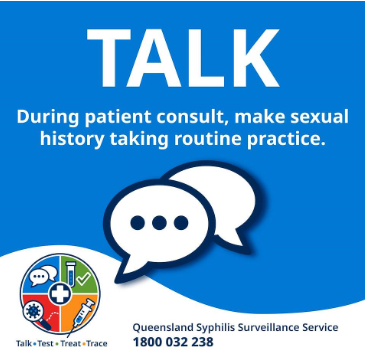
During September, the Queensland Syphilis Surveillance Service (QSSS) focuses on the critical role of general practitioners in responding to the syphilis outbreak in our community. Clinicians are asked to consider, “Could this be Syphilis?”, and take time to Talk, Test, Treat, and Trace.
This week we focus on TALK.
High syphilis infection rates remain amongst priority populations; however, there is an alarming surge in infections amongst women of reproductive age. This has resulted in an increase of pregnant women with syphilis infection, and a rise in congenital syphilis cases.
Health practitioners should be alerted to the outbreak, routinely discuss sexual health with patients, and prioritise testing for syphilis. Be aware that syphilis can present with atypical symptoms or be entirely asymptomatic, and vertical transmission can occur during any time during pregnancy, and at any stage of syphilis.
Have open discussions with patients, normalise sexual health conversations, and strengthen your clinical knowledge on syphilis. Without open dialogue, opportunities for early detection, prevention, and treatment are easily missed. Clinicians can strengthen their confidence by utilising tools such as the ASHM Conversation Guide, and how to take a sexual history.
For more information, call QSSS on 1800 032 238