
Cultural awareness and role development for GP and practice team in cancer screening for patients from culturally and linguistically diverse (CALD) backgrounds


About the practice
Operating in the heart of Sunnybank Hills.
The practice is a small, single-doctor GP clinic with a strong focus on preventive medicine. Majority of their patients are from diverse Chinese language-speaking backgrounds. Languages spoken by patients include Cantonese, Hokkien and Mandarin.
The practice prioritises quality improvement, teamwork and culturally responsive care.
What inspired the practice to complete this QI activity?
The practice was inspired to take actions after identifying lower-than-average cancer screening participation rates among patients. As practice is committed to preventive medicine, they recognised this as a great opportunity to improve health outcomes in their community.
Their main goal was to increase bowel and cervical cancer screening rates for patients. To achieve this, they aimed to reduce the communication barrier and empower patients through cancer and screening education, demonstrating that even a small practice can make a significant contribution to patient health outcomes.
The challenge
When reviewing practice data using the Primary Sense PIPQI 10 Measures report, the practice identified that participation in both the National Cervical Screening Program and National Bowel Cancer Screening Program was significantly lower than average. Three key barriers included:
lack of awareness of screening programs
language barriers and limited understanding of medical terms
cultural hesitancy and misconceptions around cancer and preventive tests.
What we did
In collaboration with GPQI coordinator, the GP and practice manager developed a culturally sensitive, patient-centred approach to increase cancer screening uptake. This includes:
bilingual education: obtained explanations and resources about cancer screening in both English and relevant languages
GP-led conversations: integrated screening discussions into routine consultations. The GP also provided a quick demo to patients on how to complete the test, addressed patient’s concerns and queries about cancer screening
family-centred engagement: practice encouraged patients to share knowledge with family members
collaborative effort: practice manager and reception staff supported patients with request forms, government letters, and bowel kit use.
Results and impact
A marked increase in bowel and cervical screening uptake.
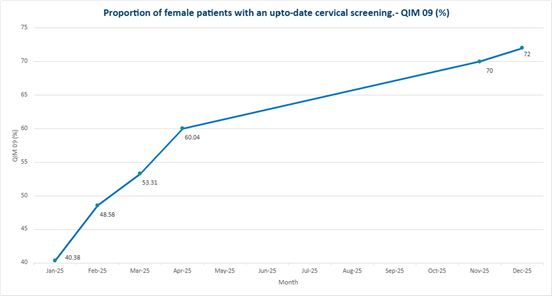
cervical screening – significant improvement proportion of female patients with an up-to-date cervical screening. from 40.38% (Jan 25) to 72% (December 25) –see Graph 1.
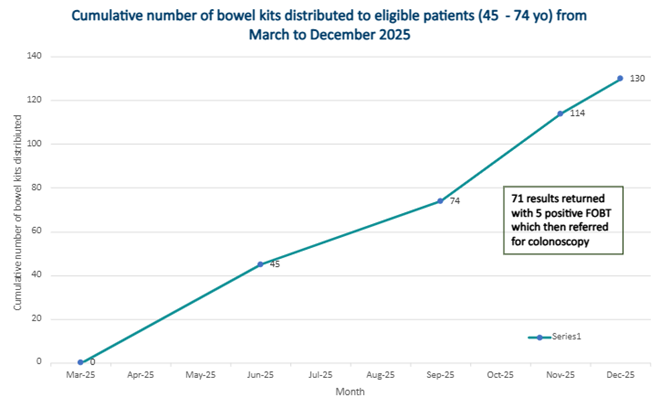
bowel cancer screening – a total of -130 bowel kits distributed to eligible patients (45-74 years old) over eight-month period from March to December 2025, see graph 2 , with 71 results returned. 5 patients had positive FOBT test which then referred to gastroenterologist for colonoscopy.
Other significant impacts:
patients also reported feeling more confident and supported, especially when spoken in Mandarin and other Chinese language.
families became more engaged in preventive health, broadening the reach of the message.
It was a clear demonstration that even a single-doctor practice can achieve meaningful patient health outcomes with tailored strategies.
What will the practice do to ensure this becomes business as usual
screening discussions will remain a routine part of GP consultations.
bilingual resources will be kept up to date and available for all patients.
GP and practice staff will continue to provide practical support for patients navigating screening programs.
progress will be monitored through ongoing data review to maintain high participation rates.
What can other practices do to participate? (Key messages for other practices)
tailor communication: Use language and cultural context familiar to your patient population.
integrate preventative medicine into routine care: Make screening a standard discussion point in primary care visits.
support patients practically: Assist with request forms, instructions, and government program navigation. Use simple language to build the trust and confident.
engage families: Encourage community-wide awareness by involving patients’ families.
Share your success
Have your recently completed a QI activity? Share your results with the General Practice Quality Improvement team.
Contact General Practice Quality Improvement
Phone: 07 3864 7540