
First Nations Quality Improvement Project


About the practice
Morningside Family Medical Centre services a culturally and linguistically diverse (CALD) patient population, with a significant proportion of patients managing chronic health conditions. The clinic also provides care for over 200 patients who identify as Aboriginal and/or Torres Strait Islander.
What inspired the practice to complete this QI activity?
The practice wanted to identify and provide appropriate care and outcomes to patients who identify as First Nations peoples and those from Culturally and Linguistically diverse backgrounds.
It was also brought to the attention of the practice team that a young patient, who identified as First Nations, had never previously received any of the additional immunisations recommended for First Nations children in Queensland.
This case prompted the practice team to reflect on how such gaps could be proactively identified and addressed for all patients.
The challenge
lack of staff awareness regarding the ability to search for eligible patients using clinical software searches
opportunity for cultural awareness training for staff and further connection with local First Nations community services
“DNA” to appointments - patients who do not attend booked appointments
further education was needed regarding available Australian Immunisation Register (AIR) reports
What we did
Setting Goals
The practice identified a need for a more systematic and culturally safe approach to care for First Nations patients. The key goals developed included:
ensuring all patients who identify as Aboriginal and Torres Strait Islander are offered additional recommended vaccinations
improving cultural competency within the team to deliver more respectful and informed car
strengthening relationships with local Indigenous health services and community supports
Quality Improvement Actions
To achieve these goals, the practice implemented the following actions:
Cultural Awareness Training
All staff members were offered cultural safety and awareness training to improve their understanding of the health needs, histories, and experiences of Aboriginal and Torres Strait Islander peoples.Strengthen Community Connections
The practice improved its connection with external services such as the Institute for Urban Indigenous Health (IUIH) and MOBLINK.Enhance Identification and Recording of Ethnicity Status
Staff were encouraged to consistently and respectfully "ask the question" regarding patients’ ethnicity status This ensured more accurate recording and helped identify those eligible for additional supports.Use Australian Immunisation Register (AIR) reports to identify eligible First Nations patients overdue for immunisations
Eligible patients were then educated about services available to them, such as:the 715 Health Assessment
CTG PBS registration
catch-up immunisations
Additionally, access to culturally appropriate patient resources was improved, allowing better support and informed decision-making.
Results and impact
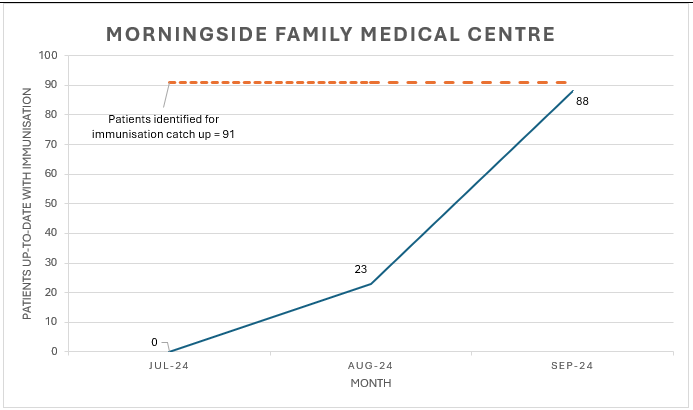
At the beginning of August 2024, 91 First Nations patients were identified as overdue for immunisation catch-up. By the end of the month, 23 of these were up-to-date. By September 2024, 88 of those eligible patients were up-to-date with immunisation.
This was a significant accomplishment achieved in a short period, made possible by the practice’s focused efforts on this topic and a clear reflection of their commitment to driving change in this area.
What will the practice do to ensure this becomes business as usual
continue to keep open line of communication with patients and routinely ensure all patients have ethnicity status recorded
continue to use available AIR reports to identify eligible patients that may be due for immunisation catch-up
offer tailored support to patients, which fosters lasting and trusting relationships to provide appropriate patient care
What can other practices do to participate? (Key messages for other practices)
ask the question! Ensure your practice is routinely asking for ethnicity status and recording this in patient files
ensure all patients have an ethnicity status recorded, which supports to identify First Nations status
if a patient identifies as Aboriginal or Torres Strait Islander, regular checks could be incorporated within the practice to check if they have had a 715 health assessment, CTG/PBS registration, immunisation status and other services potentially required
consider use of AIR reports to identify eligible patients for immunisation
work toward improved understanding and connection with local community services
Share your success
Have your recently completed a QI activity? Share your results with the General Practice Quality Improvement team.
Contact General Practice Quality Improvement
Phone: 07 3864 7540