
Supporting glycaemic control for patients with diabetes and a HbA1c > 7%


There is strong evidence that better glycaemic control (7.0% and under) can reduce some diabetic complications such as retinopathy, nephropathy and clinical neuropathy. It is also established that HbA1c is a strong predictor of cardiovascular events and mortality in patients with diabetes.*1,*2
It has been shown that elevated HbA1c levels ≥7.5% incrementally and significantly increased future risks of ischemic stroke, CVD and all-cause death.*3
Potential complications of a high HbA1c may include – kidney disease, eye disease, neuropathy, stroke, and CVD.
QI activity overview
What is the aim of this QI activity?
identify 2 patients living with diabetes that have a HbA1c ≥7%
review and provide individualised support, management and appropriate interventions for these patients
assess and implement strategies to improve overall glycaemic control
What will I need to do?
use Primary Sense Diabetes Mellites report to identify 2 patients with diabetes that have a HbA1c ≥7%
set reminder / or internal prompts for selected patients to attend for review if no upcoming appointment.
Refer to details below to assist with these steps.
How will I complete this activity?
review 2 clinical records of patients with a HbA1c ≥7%
update relevant information e.g. Pathology from MyHR
review options for each patient
implement recall where appropriate
implement relevant support/care plan/education where appropriate
Where do I document my results?
optional - Quality Improvement meeting minutes
optional - Model for improvement/PDSA template
Your own version for reference
Who can I contact for support?
For support with this activity please contact the General Practice Quality Improvement team on 38647540 or email [email protected]
Step 1: Start your activity
Review your current approach to providing support for patients living with diabetes with an elevated HbA1c.
Consider your practice team members, who is responsible for review of HbA1c results for patients living with diabetes. Ensure the team members responsible have appropriate access to current diabetes management guidelines, supports and resources. Refer to resource section below.
Identify 2 patients living with diabetes that have an elevated HbA1c that would be appropriate to review.
Once you have a database that represents your existing active patient base, use Primary Sense to identify patients with diabetes that have a HbA1c > 7%.
Recommended report:
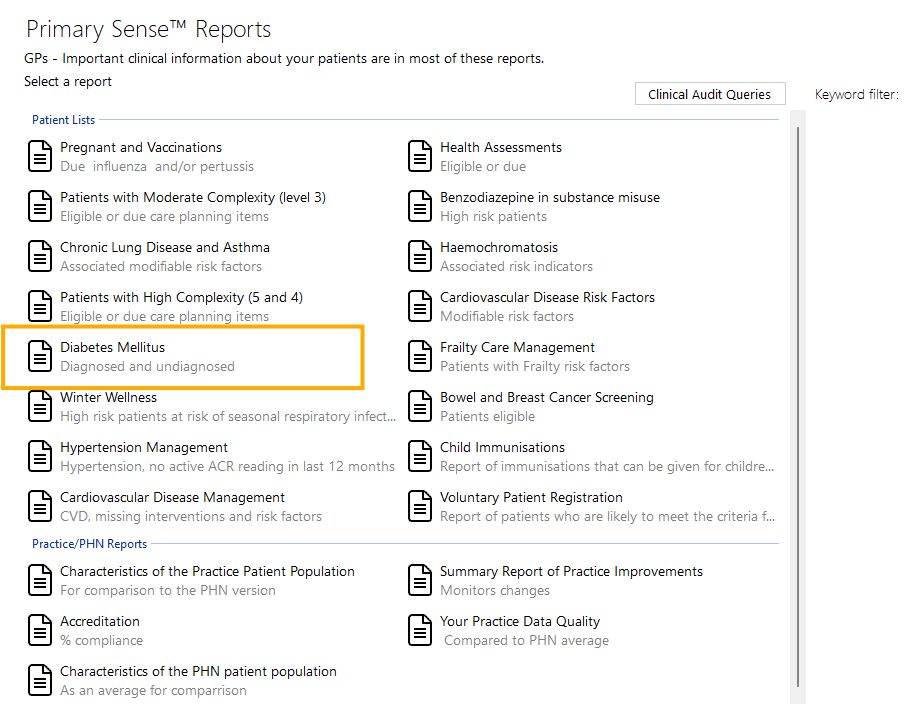
Open the report and scroll down to the table titled – “Patients with diabetes who may be eligible for chronic care occasions of service report.”
Tip - To identify a specific doctors list of potential patients for review –
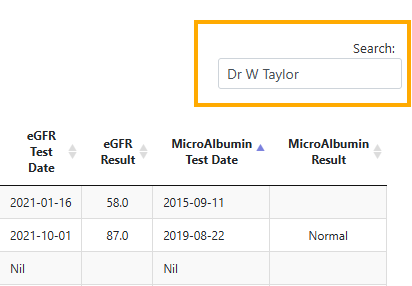
In the top right-hand side of the “Patients with diabetes who may be eligible for chronic care occasions of service” report is a “Search” area
Type in the name of the doctor you wish to view patients for and hit enter.
Example: Searching for “Dr. Taylor” will now display only that doctor’s patients-
Next - The column titled “HbA1c result %” can be used to identify patients with an elevated HbA1c. Click on this column to bring the highest HbA1c to the top.
Tip: There is an “existing appointment” column which identifies if the patient has a booked appointment at the time the report is generated.
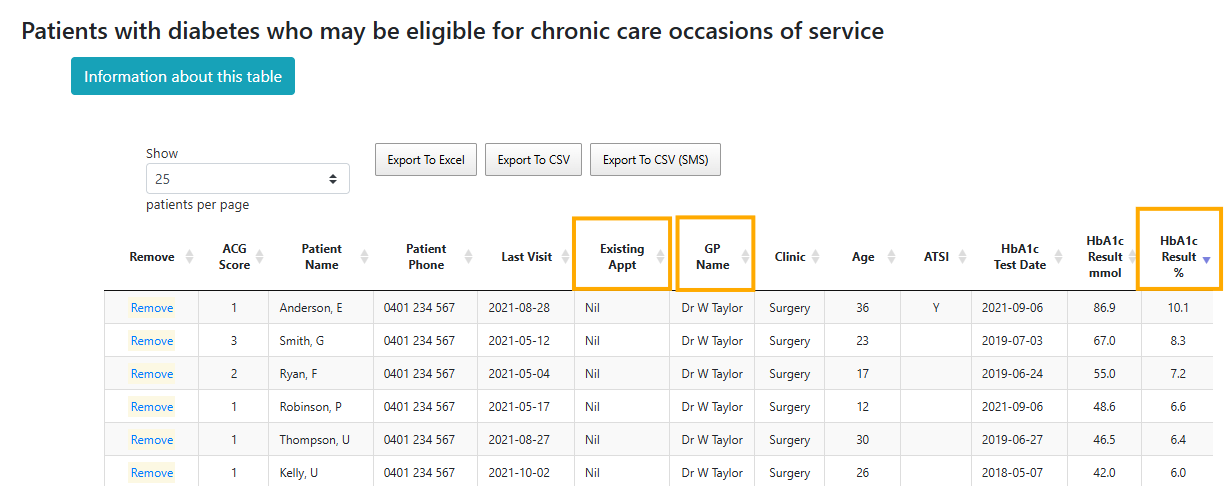
Optional: the Primary Sense report can be extracted for ease of use and saved as an Excel file which allows for simple sorting of data.
Review the list of patients to decide which 2 are to be reviewed.
Once you have identified your 2 patients for review, consider what interventions may be appropriate for the patient. Below is a list of suggestions.
Potential ideas:
if patient has an existing appointment, consider reviewing patient file prior to the visit to identify opportunities to support improved glycaemic control.
if the patient does not have existing appointment, consider setting up a recall, if appropriate.
review patient file for opportunities and consider if they have appropriate glycaemic control for their individual circumstances.
creation or review of GPCCMP (965 or 967)
Nurse support to improve patient education and engagement towards achieving patient care plan goals utilising practice nurse MBS items for chronic disease monitoring and support (10997 or 93203)
consideration for referral to credentialled diabetes educator, dietitian or other appropriate Health Care Professional under a GPCCMP
Endocrinologist referral if appropriate
review list of medications – consideration for home medicines review (HMR)
Once review is completed and appropriate actions taken set reminder for 3-6 months to review patient progress and ongoing glycaemic control.
Document and share your results
Document results of the activity. You can also document your results in the QI summary register or MFI/PDSA.
Step 2: Track your results
Suggested measures and data sources
manually record the patient names, areas reviewed and document interventions.
an individual list can be used to tick off areas of review, plan and implementation therefore tracking progress
utilise clinical information to ascertain patient baseline
utilise your clinical software to set review/recall for patient for 3-6 months HbA1c
after a 3–6-month period, note any improvements or changes in glycaemic control.
Step 3: Complete and reflect on your activity
As a team, reflect on how the activity went.
What were the challenges/barriers?
What worked well?
Are there other patients with diabetes in your practice that would benefit from a review. If yes, refer back to Step 1.
Example of completed QI activity
Resources to support with your activity
References
1. The Association Between Sustained HbA1c Control and Long-Term Complications Among Individuals with Type 2 Diabetes: A Retrospective Study - PMC [NF1] [SK2] [NF3]
3. The Impact of Diabetes Mellitus and Corresponding HbA1c Levels on the Future Risks of Cardiovascular Disease and Mortality: A Representative Cohort Study in Taiwan
https://pmc.ncbi.nlm.nih.gov/articles/PMC4395238/#:~:text=Elevated%20HbA1C%20levels%20were%20associated%20with%20increased,risks%20of%20cardiovascular%20disease%20and%20all%2Dcause%20death.&text=Several%20observational%20studies%20demonstrated%20that%20a%20higher,risks%20of%20cardiovascular%20diseases%20and%20deaths%20[2%E2%80%934].
We appreciate your feedback!
Our Quality Improvement Team works with general practices to provide practical advice and resources to help plan, implement, and review your QI activities. Your feedback helps our team to provide the best possible support for your practice.
Contact General Practice Quality Improvement
Phone: 07 3864 7540