
Improving spirometry recording for your COPD patients


This self-paced Quality Improvement (QI) activity supports general practices to strengthen the diagnosis and ongoing management of Chronic Obstructive Pulmonary Disease (COPD) through the appropriate use and documentation of spirometry.
Accurate spirometry results are essential for:
confirming COPD diagnosis
guiding treatment decisions, and
reducing the risk of potentially preventable hospitalisations.
This activity focuses on identifying patients with a recorded COPD diagnosis who do not have spirometry results documented in their clinical record and implementing a structured process to address these gaps.
QI activity overview
What is the aim of this QI activity?
The aim of this QI activity is to:
to improve the use of spirometry to inform diagnosis of COPD
identify 10 COPD patients missing a recorded spirometry result and ensure results are documented or patients are recalled for spirometry.
support evidence-based COPD management
What will I need to do?
run a Primary Sense report to identify COPD patients without recorded spirometry
review patient clinical records
source spirometry results completed externally, where applicable
recall suitable patients for spirometry testing
How will I complete this activity?
recall identified patients to attend spirometry with the Practice Nurse or GP
perform and record spirometry results in the clinical system
upload external spirometry results into the patient record once received
Where do I document my results?
Who can I contact for support?
For support with this activity please contact the General Practice Quality Improvement team on 38647540 or email [email protected].
Step 1: Start your activity
1. Identify patients with COPD that are missing a recorded spirometry.
Using Primary Sense, run the Chronic Lung Disease and Asthma report.
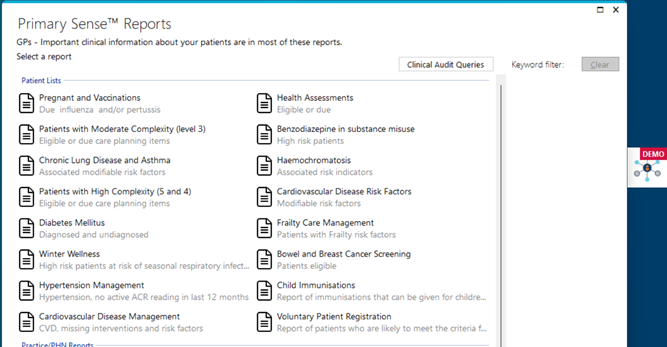
Using the search function, search for COPD or Chronic Obstructive Pulmonary Disease (depending on how your practice codes the condition). This will filter the report to those patients with a COPD diagnosis coded in their patient record.
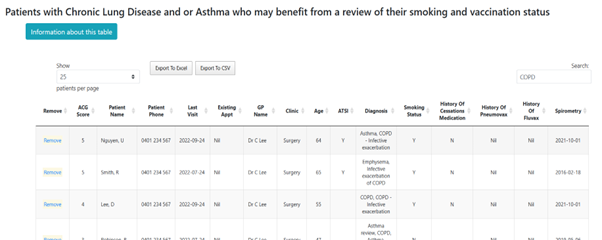
The column titled ‘Spirometry’ can be used to identify patients who do not have a spirometry recorded in their clinical record.
2 - Review clinical records
Once you have identified ten patients who do not have a spirometry recorded in the above report, you can then review each clinical record to check:
are there any results under the ‘in-correspondence/results’ section as a PDF or image?
has the GP indicated in ‘free text’ that a spirometry had been completed elsewhere?
If spirometry is performed internally, some clinical software will directly import the results into the appropriate fields. If this does not occur and you must enter results manually, please consult your software provider's manual:
3. Set up recalls and/or prompts for patients
The Spirometry Handbook for primary care and the COPD-X Handbook provide clinical guidance on the use of spirometry for the diagnosis of COPD and monitoring. For your identified patients with COPD, where it is confirmed that no spirometry has been noted, discuss the findings with their regular GP. Confirm with the patient’s regular GP prior to recalling the patient to book in for spirometry or referral to a Respiratory service to perform the spirometry externally.
4. Document and share your results
You can document your results in the QI summary register or MFI/PDSA templates and display them in the treatment room or lunchroom so that team members can see the impact of their changes.
Step 2: Track your results
Suggested measures and data sources
re-run the Chronic Lung Disease and Asthma Primary Sense report as shown above and compare updated spirometry entries.
or
manually record the number of COPD patients identified as missing a spirometry and the number of patients that have since had spirometry records updated and/or spirometry performed.
Step 3: Complete and reflect on your activity
As a team, reflect on how the activity went.
what were the challenges/barriers?
what worked well?
are there any small changes that you could implement to continue improving your recorded spirometry rates?
share your results with your team and Brisbane South PHN (you can do this by clicking on the I’ve completed this activity button below).
as next steps you might like to start Improving pneumococcal and influenza vaccination rates for patients with COPD | Brisbane South PHN
Example of completed QI activity
Resources to support with your activity
We appreciate your feedback!
Our Quality Improvement Team works with general practices to provide practical advice and resources to help plan, implement, and review your QI activities. Your feedback helps our team to provide the best possible support for your practice.
Contact General Practice Quality Improvement
Phone: 07 3864 7540